17+ Ehlers danlos syndrome type 3 information
Home » diy info » 17+ Ehlers danlos syndrome type 3 informationYour Ehlers danlos syndrome type 3 images are available. Ehlers danlos syndrome type 3 are a topic that is being searched for and liked by netizens today. You can Download the Ehlers danlos syndrome type 3 files here. Download all free photos and vectors.
If you’re searching for ehlers danlos syndrome type 3 images information linked to the ehlers danlos syndrome type 3 keyword, you have come to the right blog. Our website frequently gives you hints for downloading the highest quality video and picture content, please kindly search and find more enlightening video content and images that fit your interests.
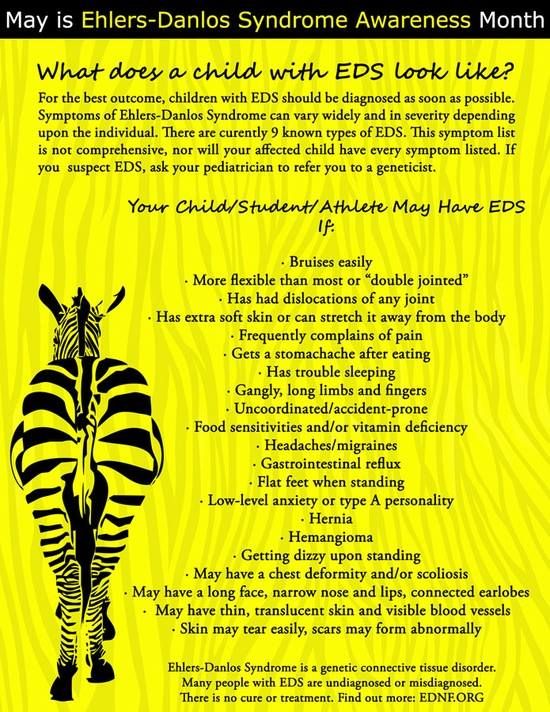
Ehlers Danlos Syndrome Type 3. The basic idea by doctors ehlers and danlos remains somewhat intact today: The signs and symptoms of eds vary by type and range from. Subluxations and dislocations are common; The most common eds symptoms include overly flexible joints, stretchy or loose skin and easy bruising.
 Day 13 of 1 A Day in May Raising Awareness with Tay From pinterest.com
The most common eds symptoms include overly flexible joints, stretchy or loose skin and easy bruising. These tissues—found mostly in the skin, joints, and blood vessel walls—act like a glue to help provide strength and elasticity to the body’s structures, including the digestive system and essential organs. Frequent joint dislocations and subluxations (partial dislocation), often affecting the shoulder, kneecap, and/or temporomandibular joint (joint that connects the lower jaw to the skull) Sometimes the faulty gene is not inherited, but occurs in the person for the first time. Hyperlaxity is a normal varia. Subluxations and dislocations are common;
Symptoms may include loose joints, joint pain, stretchy velvety skin, and abnormal scar formation.
Joint hypermobility affecting both large (elbows, knees) and small (fingers, toes) joints; Depending on the type of eds, the faulty gene may have been inherited from 1 parent or both parents. These tissues—found mostly in the skin, joints, and blood vessel walls—act like a glue to help provide strength and elasticity to the body’s structures, including the digestive system and essential organs. These can be noticed at birth or in early childhood. This means that a child cannot inherit a different type of eds to the one their parent has. They are generally characterized by joint hypermobility (joints that stretch further than normal), skin hyperextensibility (skin that can be stretched further than normal), and tissue fragility.
 Source: pinterest.com
The basic idea by doctors ehlers and danlos remains somewhat intact today: Subluxations and dislocations are common; This means that a child cannot inherit a different type of eds to the one their parent has. Individuals with eds demonstrate defects in the body�s connective tissues, manifesting as altered strength, elasticity, integrity, and healing properties of the tissues. Those affected have trouble with hyperflexibility as well as oddly fragile and stretchy skin.
 Source:
This means that a child cannot inherit a different type of eds to the one their parent has. Subluxations and dislocations are common; There a number of types of eds, each affecting the body in a different way. These can be noticed at birth or in early childhood. The skin is often soft and may be mildly hyperextensible.
 Source: pinterest.com
The skin is often soft and may be mildly hyperextensible. Some of the rare, severe types can be life threatening. The skin is often soft and may be mildly hyperextensible. These are things like tendons and ligaments that hold parts of your body together. Hyperlaxity is a normal varia.
 Source: pinterest.com
They may occur spontaneously or with minimal trauma and can be acutely painful. Those affected have trouble with hyperflexibility as well as oddly fragile and stretchy skin. They are generally characterized by joint hypermobility (joints that stretch further than normal), skin hyperextensibility (skin that can be stretched further than normal), and tissue fragility. This means that a child cannot inherit a different type of eds to the one their parent has. The skin is often soft and may be mildly hyperextensible.
 Source: pinterest.com
Joint hypermobility affecting both large (elbows, knees) and small (fingers, toes) joints; This is a video explaining the most important characteristics of this condition. The most common eds symptoms include overly flexible joints, stretchy or loose skin and easy bruising. 31 years experience orthopedic surgery. Problems of diagnosis and management.
 Source:
31 years experience orthopedic surgery. These are things like tendons and ligaments that hold parts of your body together. 31 years experience orthopedic surgery. Appearance of multiple bruises especially on legs, splitting of skin over forehead, chin, knees and elbows is usually seen in childhood. Despite this grouping and their common name, each type is a distinct condition caused by a different gene mutation.
 Source: pinterest.com
This is a video explaining the most important characteristics of this condition. They also have thin, translucent skin that bruises very easily. Some of the rare, severe types can be life threatening. Classical features of ehlers danlos syndrome or eds may include doughy, soft, hyper elastic skin. Complications may include aortic dissection, joint dislocations, scoliosis, chronic pain, or early osteoarthritis.
Source: pinterest.com
The skin is often soft and may be mildly hyperextensible. Subluxations and dislocations are common; These can be noticed at birth or in early childhood. They also have thin, translucent skin that bruises very easily. The skin is often soft and may be mildly hyperextensible.
 Source: pinterest.com
Symptoms may include loose joints, joint pain, stretchy velvety skin, and abnormal scar formation. There a number of types of eds, each affecting the body in a different way. The skin is often soft and may be mildly hyperextensible. 31 years experience orthopedic surgery. These can be noticed at birth or in early childhood.
 Source: pinterest.com
Despite this grouping and their common name, each type is a distinct condition caused by a different gene mutation. Depending on the type of eds, the faulty gene may have been inherited from 1 parent or both parents. These are things like tendons and ligaments that hold parts of your body together. Eds occurs due to variations of more than 19. These can be noticed at birth or in early childhood.
 Source: pinterest.com
The skin is often soft and may be mildly hyperextensible. Symptoms may include loose joints, joint pain, stretchy velvety skin, and abnormal scar formation. These can be noticed at birth or in early childhood. This means that a child cannot inherit a different type of eds to the one their parent has. Individuals with eds demonstrate defects in the body�s connective tissues, manifesting as altered strength, elasticity, integrity, and healing properties of the tissues.
 Source:
Hyperlaxity is a normal varia. 3 heim a, raghunath m, meiss l, heise u, myllyla r, kohlschutter a, steinmann b (1998). Eds occurs due to variations of more than 19. The most common eds symptoms include overly flexible joints, stretchy or loose skin and easy bruising. They also have thin, translucent skin that bruises very easily.
 Source: pinterest.com
Subluxations and dislocations are common; Sometimes the faulty gene is not inherited, but occurs in the person for the first time. The most common eds symptoms include overly flexible joints, stretchy or loose skin and easy bruising. Hyperlaxity is a normal varia. The basic idea by doctors ehlers and danlos remains somewhat intact today:
 Source:
Appearance of multiple bruises especially on legs, splitting of skin over forehead, chin, knees and elbows is usually seen in childhood. The signs and symptoms of eds vary by type and range from. Classical features of ehlers danlos syndrome or eds may include doughy, soft, hyper elastic skin. Subluxations and dislocations are common; Symptoms may include loose joints, joint pain, stretchy velvety skin, and abnormal scar formation.
 Source: pinterest.com
3 heim a, raghunath m, meiss l, heise u, myllyla r, kohlschutter a, steinmann b (1998). These tissues—found mostly in the skin, joints, and blood vessel walls—act like a glue to help provide strength and elasticity to the body’s structures, including the digestive system and essential organs. Subluxations and dislocations are common; The most common eds symptoms include overly flexible joints, stretchy or loose skin and easy bruising. Some of the rare, severe types can be life threatening.
 Source:
They may occur spontaneously or with minimal trauma and can be acutely painful. Some of the rare, severe types can be life threatening. Individuals with eds demonstrate defects in the body�s connective tissues, manifesting as altered strength, elasticity, integrity, and healing properties of the tissues. There a number of types of eds, each affecting the body in a different way. Classical features of ehlers danlos syndrome or eds may include doughy, soft, hyper elastic skin.
 Source: pinterest.com
Individuals with eds demonstrate defects in the body�s connective tissues, manifesting as altered strength, elasticity, integrity, and healing properties of the tissues. Symptoms may include loose joints, joint pain, stretchy velvety skin, and abnormal scar formation. They also have thin, translucent skin that bruises very easily. Joint hypermobility affecting both large (elbows, knees) and small (fingers, toes) joints; Those affected have trouble with hyperflexibility as well as oddly fragile and stretchy skin.
 Source: pinterest.com
Sometimes the faulty gene is not inherited, but occurs in the person for the first time. Complications may include aortic dissection, joint dislocations, scoliosis, chronic pain, or early osteoarthritis. Problems of diagnosis and management. 31 years experience orthopedic surgery. Individuals with eds demonstrate defects in the body�s connective tissues, manifesting as altered strength, elasticity, integrity, and healing properties of the tissues.
This site is an open community for users to submit their favorite wallpapers on the internet, all images or pictures in this website are for personal wallpaper use only, it is stricly prohibited to use this wallpaper for commercial purposes, if you are the author and find this image is shared without your permission, please kindly raise a DMCA report to Us.
If you find this site good, please support us by sharing this posts to your own social media accounts like Facebook, Instagram and so on or you can also save this blog page with the title ehlers danlos syndrome type 3 by using Ctrl + D for devices a laptop with a Windows operating system or Command + D for laptops with an Apple operating system. If you use a smartphone, you can also use the drawer menu of the browser you are using. Whether it’s a Windows, Mac, iOS or Android operating system, you will still be able to bookmark this website.
Category
Related By Category
- 13+ Diy crafts to do at home for adults ideas
- 11++ Diy concrete countertops with sink ideas
- 16++ Diy mundschutz naehen fuer erwachsene und kinder ideas
- 16+ Diy masks for acne prone skin info
- 20+ Diy snow white outfit ideas
- 14++ Diy wreath kit near me information
- 13+ Diy christmas tree topper ribbon info
- 18++ Diy garage door christmas decorations info
- 14+ Easy diy crafts to do at home with paper ideas in 2021
- 12++ Diy grinch costume child ideas